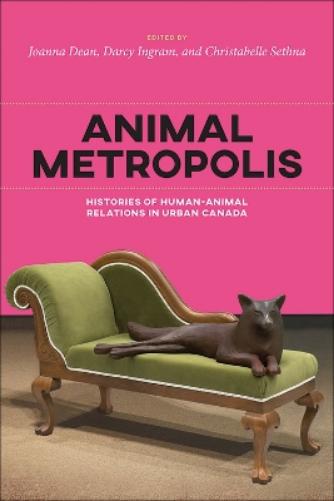
Animal Metropolis
Histories of Human-Animal Relations in Urban Canada The authors collectively push forward from a historiography that features nonhuman animals as objects within human-centered inquiries to a historiography that considers the eclectic contacts, exchanges, and cohabitation of human and nonhuman animals.
Offers a diverse array of work on the historical study of human-animal relations in Canada. In doing so, it aims to create a starting point for an ongoing conversation about the place of animals in historical analysis and, in turn, about the way issues regarding animals fit into Canada’s political, social, cultural, economic, environmental and ethical landscapes.
Animal Metropolis brings a Canadian perspective to the growing field of animal history, ranging across species and cities, from the beavers who engineered Stanley Park to the carthorses who shaped the city of Montreal. Some essays consider animals as spectacle: orca captivity in Vancouver, polar bear tourism in Churchill, Manitoba, fish on display in the Dominion Fisheries Museum, and the racialized memory of Jumbo the elephant in St. Thomas, Ontario. Others examine the bodily intimacies of shared urban spaces: the regulation of rabid dogs in Banff, the maternal politics of pure milk in Hamilton and the circulation of tetanus bacilli from horse to human in Toronto. Another considers the marginalization of women in Canada's animal welfare movement.
Product Information
Product Information
Shipping & Returns
Shipping & Returns
Description
Histories of Human-Animal Relations in Urban Canada The authors collectively push forward from a historiography that features nonhuman animals as objects within human-centered inquiries to a historiography that considers the eclectic contacts, exchanges, and cohabitation of human and nonhuman animals.
Offers a diverse array of work on the historical study of human-animal relations in Canada. In doing so, it aims to create a starting point for an ongoing conversation about the place of animals in historical analysis and, in turn, about the way issues regarding animals fit into Canada’s political, social, cultural, economic, environmental and ethical landscapes.
Animal Metropolis brings a Canadian perspective to the growing field of animal history, ranging across species and cities, from the beavers who engineered Stanley Park to the carthorses who shaped the city of Montreal. Some essays consider animals as spectacle: orca captivity in Vancouver, polar bear tourism in Churchill, Manitoba, fish on display in the Dominion Fisheries Museum, and the racialized memory of Jumbo the elephant in St. Thomas, Ontario. Others examine the bodily intimacies of shared urban spaces: the regulation of rabid dogs in Banff, the maternal politics of pure milk in Hamilton and the circulation of tetanus bacilli from horse to human in Toronto. Another considers the marginalization of women in Canada's animal welfare movement.