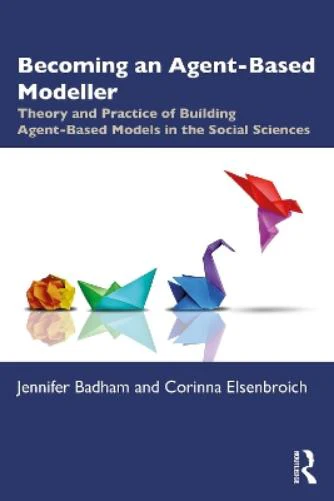
Becoming an Agent-Based Modeller
Theory and Practice of Building Agent-Based Models in the Social Sciences This book covers the theory and practice of agent-based modelling (ABM) from a novice to intermediate level. Structured to mirror a course, the book takes readers through the full development of an agent-based model, from research question, conceptualisation and design of the model, through to what to do when your model is finished. Becoming an Agent-based Modeller takes you on a journey, from curiosity about social phenomena to generating them with a computer simulation. The book introduces agent-based modelling as a method to understand societies as complex systems, systems of interconnected, interdependent, and interacting agents. The book is structured like a course rather than a textbook or reference book. The core of the book is an extended tutorial introducing the NetLogo programming language. Using the example of an epidemic, it explores how an agent-based model of social influence, situational awareness, and contextual decisions by individual agents about protective behaviour can help us understand plausible epidemic trajectories. The tutorial demonstrates how to build an agent-based model from scratch and use it in research, including the conceptualisation stage, the operationalisation and implementation, experimentation, and interpretation. This practical part of the book is embedded in chapters on theory, epistemology, and ethics of agent-based modelling. With pedagogical tools including key discussion points, illustrations, and highlighted concepts, this is an ideal resource for courses on ABM, and for postgraduate students and researchers in the social sciences and beyond, who wish to develop their understanding of agent-based modelling.
Original: $119.89
-65%$119.89
$41.96Product Information
Product Information
Shipping & Returns
Shipping & Returns
Description
Theory and Practice of Building Agent-Based Models in the Social Sciences This book covers the theory and practice of agent-based modelling (ABM) from a novice to intermediate level. Structured to mirror a course, the book takes readers through the full development of an agent-based model, from research question, conceptualisation and design of the model, through to what to do when your model is finished. Becoming an Agent-based Modeller takes you on a journey, from curiosity about social phenomena to generating them with a computer simulation. The book introduces agent-based modelling as a method to understand societies as complex systems, systems of interconnected, interdependent, and interacting agents. The book is structured like a course rather than a textbook or reference book. The core of the book is an extended tutorial introducing the NetLogo programming language. Using the example of an epidemic, it explores how an agent-based model of social influence, situational awareness, and contextual decisions by individual agents about protective behaviour can help us understand plausible epidemic trajectories. The tutorial demonstrates how to build an agent-based model from scratch and use it in research, including the conceptualisation stage, the operationalisation and implementation, experimentation, and interpretation. This practical part of the book is embedded in chapters on theory, epistemology, and ethics of agent-based modelling. With pedagogical tools including key discussion points, illustrations, and highlighted concepts, this is an ideal resource for courses on ABM, and for postgraduate students and researchers in the social sciences and beyond, who wish to develop their understanding of agent-based modelling.