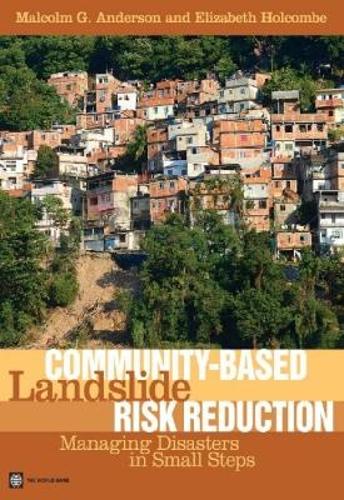
Community-based Landslide Risk Reduction
Managing Disasters in Small Steps
Details the MoSSaiC (Management of Slope Stability in Communities) methodology, which aims to create behavioural change in vulnerable communities in developing countries. It deals with the landslide hazard trigger most relevant to vulnerable urban communities in developing countries: rainfall-induced instability on soil slopes.
The handbook details the MoSSaiC (Management of Slope Stability in Communities) methodology, which aims to create behavioral change in vulnerable communities in developing countries. It deals with the landslide hazard trigger most relevant to vulnerable urban communities in developing countries: rainfall-induced instability on soil slopes. Focusing on maximizing within-country capacity to deliver landslide mitigation measures on the ground, it provides an end-to-end blueprint for the mitigation process: building the necessary teams, detailed community-based slope stability assessment, construction of drainage measures for reducing the hazard, and the audit of outputs and outcomes. This book is a resource for policy-makers, project managers, and practitioners in developing countries.
Original: $73.26
-65%$73.26
$25.64Product Information
Product Information
Shipping & Returns
Shipping & Returns
Description
Managing Disasters in Small Steps
Details the MoSSaiC (Management of Slope Stability in Communities) methodology, which aims to create behavioural change in vulnerable communities in developing countries. It deals with the landslide hazard trigger most relevant to vulnerable urban communities in developing countries: rainfall-induced instability on soil slopes.
The handbook details the MoSSaiC (Management of Slope Stability in Communities) methodology, which aims to create behavioral change in vulnerable communities in developing countries. It deals with the landslide hazard trigger most relevant to vulnerable urban communities in developing countries: rainfall-induced instability on soil slopes. Focusing on maximizing within-country capacity to deliver landslide mitigation measures on the ground, it provides an end-to-end blueprint for the mitigation process: building the necessary teams, detailed community-based slope stability assessment, construction of drainage measures for reducing the hazard, and the audit of outputs and outcomes. This book is a resource for policy-makers, project managers, and practitioners in developing countries.